

Key Takeaways
- Slippage is the difference between the price you expect and the price at which an order actually executes.
- Slippage can be positive or negative.
- Fast markets and low liquidity generally increase slippage risk.
- Stop-loss orders do not always guarantee an exact exit price.
- High-impact economic news can produce unusually large execution differences.
- Larger positions can make the monetary impact of slippage more significant.
- Slippage can contribute to prop firm drawdown even when a trader uses a stop-loss.
- Traders should distinguish normal market slippage from poor platform execution.
- Risk management should account for the possibility that actual losses may occasionally exceed planned losses.
You place a buy order at 1.2500. But when you check the trade, your actual entry price is 1.2503. What happened? The three-pip difference is an example of slippage.
Slippage occurs when an order is executed at a different price from the one a trader expected. It can happen in Forex, futures, stocks, indices, commodities, cryptocurrencies, and virtually any actively traded market. Sometimes slippage works against you; sometimes it works in your favor.
For prop traders, however, understanding slippage is particularly important because unexpected execution prices can increase losses, affect stop-losses, and move an account closer to Maximum Daily Loss or Maximum Drawdown limits. Slippage becomes especially noticeable during fast-moving markets, major economic announcements, market openings, and periods of reduced liquidity.
This guide explains exactly how slippage works, why it happens, how it affects prop firm accounts, and what traders can realistically do to reduce execution risk.
Quick Facts
| Topic | Details |
|---|---|
| Category | Prop Firm Basics |
| Difficulty | Beginner |
| Main Topic | Slippage and trade execution |
| Best For | Forex, CFD, futures and crypto prop traders |
| Search Intent | Informational |
| Last Updated | August 2026 |
What Is Slippage?
Slippage is the difference between the price a trader expects when submitting an order and the price at which the order actually gets executed. Suppose EUR/USD is trading at 1.1000. You submit a market buy order. By the time the order reaches the market and liquidity is available, the best executable price is 1.1002. Your order fills two pips above the price you originally saw. That is negative slippage because the resulting entry is less favorable.
But imagine your order instead executes at 1.0998. You received a better price than expected. That is positive slippage. Slippage therefore does not automatically mean something went wrong; it can be a normal consequence of market execution dynamics.
How Does Slippage Work?
Market prices are constantly changing. When your trading platform shows EUR/USD at 1.1000, that price does not necessarily remain available until your order is executed. Between Click → Order transmission → Order matching → Execution, the available market price can shift.
Suppose the order book looks like this:
| Available Price | Available Volume |
|---|---|
| 1.1000 | 1 lot |
| 1.1001 | 2 lots |
| 1.1002 | 5 lots |
You submit an order to buy 5 lots. There may not be enough liquidity to fill the entire position at 1.1000. Parts of your order could therefore execute across different price tiers, resulting in an average fill price higher than the first quote displayed.
Positive vs Negative Slippage
Slippage works in both directions depending on order side and market momentum:
- Negative Slippage: You expect to buy at 1.2500, but get filled at 1.2504 (4 pips worse). On a sell order, receiving a lower selling price than expected represents negative slippage.
- Positive Slippage: You expect to buy at 1.2500, but get filled at 1.2497 (3 pips better). Positive slippage directly benefits the trader by improving the cost basis.
| Expected Entry | Actual Entry | Result |
|---|---|---|
| 1.2500 | 1.2504 | -4 pip negative slippage |
| 1.2500 | 1.2501 | -1 pip negative slippage |
| 1.2500 | 1.2500 | Zero slippage (Exact fill) |
| 1.2500 | 1.2498 | +2 pip positive slippage improvement |
Why Does Slippage Happen?
Several common market conditions amplify the probability and size of execution slippage:
- High Volatility: When prices move violently, quotes vanish before order matching can finalize.
- Low Liquidity: Fewer market makers and resting orders mean volume must be filled across multiple price levels.
- Large Order Sizes: Orders that exceed the top-of-book depth sweep through multiple layers of the order book.
- Economic News Announcements: High-impact macro releases cause rapid repricing within milliseconds.
- Market Openings: Weekend gaps and session transitions feature shifting liquidity dynamics.
- Market Closures and Reopenings: Weekend holding exposes trades to opening price gaps.
- Unexpected Breaking News: Geopolitical shocks or unscheduled announcements trigger instantaneous price jumps.
Slippage During Economic News
High-impact economic announcements (such as central bank rate decisions, CPI inflation data, and Non-Farm Payrolls) are the most frequent catalysts for extreme slippage. Imagine EUR/USD trading at 1.1000 before a CPI release. Within seconds, quotes jump from 1.1000 to 1.1020 to 1.1040. A trader clicking buy at 1.1005 may fill at 1.1030 or higher. This execution reality is why news trading carries substantial hidden risk.
Stop-Loss Slippage Explained
A stop-loss order instructs the trading platform to close your position once price hits a defined threshold. However, a standard stop-loss converts into a market order upon trigger—it does not guarantee an exact exit price.
Suppose you are long EUR/USD from 1.1000 with a stop-loss at 1.0950 (50 pips risk). A sudden macro event causes price to gap instantaneously from 1.0955 down to 1.0940. There were simply no bids at 1.0950. Your stop executes at 1.0940, resulting in a 60-pip loss instead of the planned 50 pips. The extra 10 pips represent stop-loss slippage.
Example: How Slippage Changes Your Risk
Suppose you trade a position where each pip is worth $20. Your planned stop distance is 25 pips ($500 expected loss). Due to high volatility, your stop slips 5 pips, closing at 30 pips ($600 actual loss). That represents a 20% increase over your planned risk. For a prop trader close to a daily limit, that execution difference can cause an unexpected breach.
Slippage vs Spread vs Commission
Beginners frequently confuse spread, commission, and slippage. All three represent components of total transaction cost:
- Spread: The static or floating difference between the bid and ask price at any given moment.
- Commission: An explicit, fixed broker fee charged per round lot traded.
- Slippage: The execution variance between the requested/expected price and the final filled price.
For example, on a single trade you might pay $20 in spread, $7 in round-turn commission, and experience $15 in negative slippage, totaling $42 in real execution friction.
How Slippage Affects Prop Firm Accounts
Slippage matters far more in prop trading than in personal retail accounts because prop firms enforce rigid loss limits: Maximum Daily Loss, Maximum Trailing Drawdown, and absolute loss thresholds.
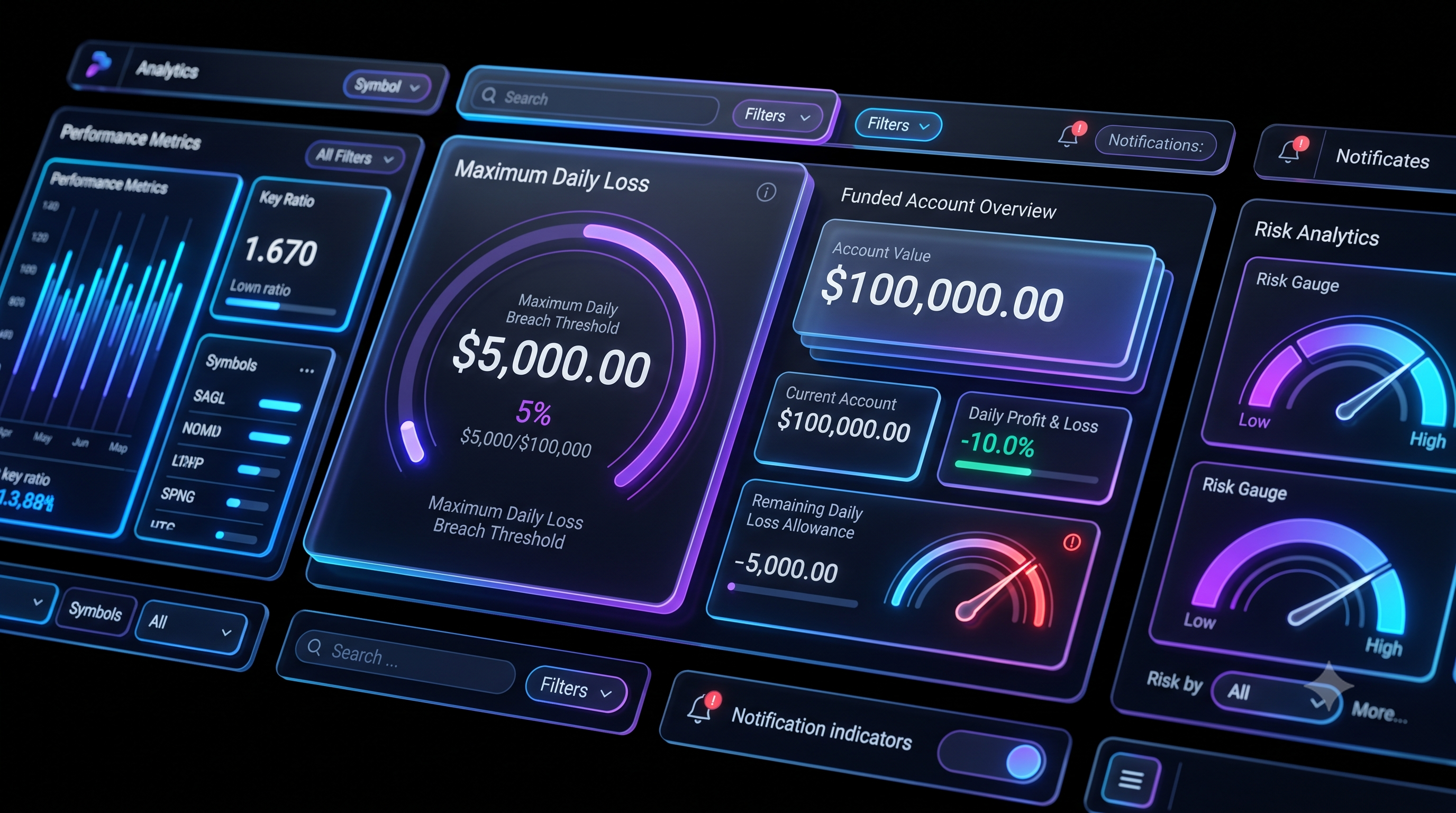
Consider a $100,000 account with a 5% Maximum Daily Loss ($5,000 allowance). If you have already lost $4,500 during the session and enter a new trade with a planned $400 risk, your theoretical risk is $4,900 (compliant). However, if your stop-loss slips by $250, your total realized daily loss reaches $5,150. The account is immediately breached. Operating on the exact boundary of a drawdown limit leaves zero tolerance for market microstructure realities.
Market Orders vs Limit Orders
Order selection directly influences your exposure to slippage:
- Market Order: Prioritizes execution certainty over price certainty. Guarantees your order fills immediately, but at the best currently available market price (subject to slippage).
- Limit Order: Prioritizes price certainty over execution certainty. Guarantees you fill at your specified price or better, but risks not filling at all if price runs away.
Which Markets Experience Slippage?
- Forex: Common during London/New York session overlap, central bank rate decisions, and exotic currency pairs.
- Futures: Fast index (NQ/ES) and energy contracts frequently experience execution jumps during economic releases.
- Stocks & Equities: Earnings gaps and market open bells trigger substantial slippage.
- Cryptocurrency: 24/7 trading with fragmented exchange liquidity creates frequent slippage events.
- Commodities: Gold (XAU/USD) and Crude Oil are particularly prone to rapid repricing around geopolitical events.
How to Reduce Slippage
- Avoid Entering Directly into High-Impact News: Wait 3 to 5 minutes after major releases for spread and liquidity to normalize.
- Trade Highly Liquid Instruments: Focus on major forex pairs, top equity indices, and primary futures contracts.
- Trade Active Session Windows: Avoid the Asian-session illiquid roll-over window between 5:00 PM and 6:00 PM EST.
- Use Limit Orders for Entries: Whenever your strategy allows, use limit orders to prevent unfavorable fill prices.
- Never Trade at Drawdown Boundaries: Maintain at least a 1% to 2% safety buffer below your prop firm's daily loss limit.
- Reduce Position Size During Volatility: Smaller lot sizes reduce the absolute dollar impact of slippage.
- Audit Platform Execution Quality: Track requested vs actual fills in your trading journal to spot chronic execution issues.
PropCompareHub Insight
💡 PropCompareHub Insight: Beginners typically evaluate prop firms solely on headline prices and profit splits. However, execution infrastructure—server latency, bridge liquidity, and spread consistency—directly dictates your survival rate. Two firms with identical 5% daily loss limits can produce vastly different outcomes if one suffers from persistent 3-pip execution slippage. Always review audited execution conditions and broker partnerships on PropCompareHub before buying an evaluation.
What to Compare Between Prop Firms
| Feature | What to Check |
|---|---|
| Trading Platform | cTrader, MT5, TradeLocker, DXtrade execution speeds |
| Spread & Commission | Raw spread vs standard markup costs |
| Slippage Experience | Community-audited fill quality and execution reports |
| Available Markets | Forex, Indices, Commodities, Crypto, and Futures liquidity |
| News Trading Policies | Whether high-impact news trading is unrestricted |
| Maximum Daily Loss | Static vs balance-based vs equity-based calculation |
| Server Latency & Uptime | Execution reliability during volatile market sessions |
Conclusion
Slippage is not an arbitrary broker fee; it is an inherent mechanic of financial markets where prices and liquidity shift continuously. In standard retail trading, a few pips of slippage is an annoyance. In proprietary trading with strict daily and trailing loss thresholds, uncalculated slippage can be fatal.
Build a protective risk buffer, size positions realistically, understand order execution mechanics, and always remember: your planned spreadsheet risk and your actual market fill are never identical.
Frequently Asked Questions
Related Guides
Prop Firm Payouts Explained: How Do Funded Traders Get Paid?
Learn how prop firm payouts work, including profit splits, payout schedules, withdrawal rules, minimum payouts, and what traders should check before choosing a firm.
What Happens If You Fail a Prop Firm Challenge?
Failed a prop firm challenge? Learn what happens to your account and fee, whether you can retry, how resets work, and what to do before buying another challenge.
Find Your Ideal Prop Firm
Answer a quick question to get personalized firm recommendations tailored to your goals.
Ready to Compare Prop Firms?
Don't settle for the first firm you find. Use our data to find the best conditions for your specific trading strategy.